Community
Join the Leadership Club
A leadership club for ambitious professionals who want to grow together. Start with 3 free chapters, unlock the full program, and join a community of fellow leaders who get it.
Get the First 3 Chapters Free
Free Guide
For leaders who think outside the box and trust an intuitive approach.


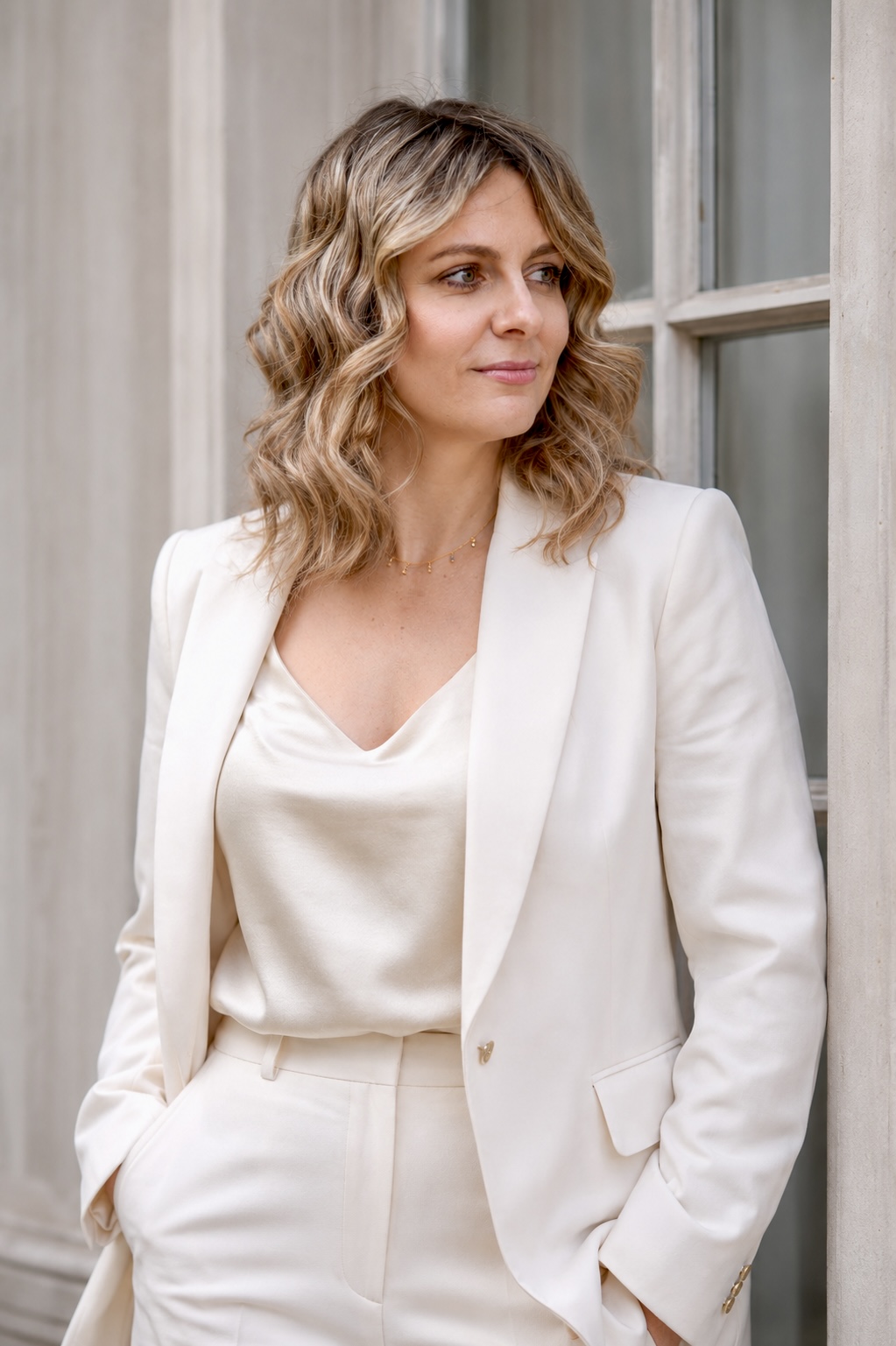
Victoria, ICF-trained leadership coach, The Hague.
A Personal Note
I have loved art since I was a child. Long before I understood why, I understood that a painting could hold something words couldn't quite reach.
That love has taken me to more than two hundred museums around the world. The Met and the Guggenheim in New York, the Louvre and the Musée d'Orsay in Paris, the Hermitage, the Pushkin, and the Tretyakov in Russia, Tate Modern and the National Gallery in London, and closer to home, the Stedelijk and the Van Gogh Museum. I volunteered for galleries in The Hague, once dreamed of studying art management, and have always found in modern art, Impressionism especially, and later Pop Art, a way of discovering culture and meaning that no textbook could offer. I remember arriving in New York and standing in front of paintings I had studied for years only in books, and feeling the particular vertigo of finally seeing them real.
Art has also been how I've built friendships across the world. Fellow travelers who measure a city not by its restaurants but by its museums. It has been a quiet, consistent thread through every chapter of my life, including the years I have spent as a leadership coach.
This year, that thread found its way into my work. Speaking with executives I coach, I noticed something: it was often easier for them to talk through a painting than to talk directly about themselves. The distance art creates is, paradoxically, what lets people get closer to the truth.
This guide is my invitation to you to try the same: five paintings, five reflections on leadership. Not based on business books, but on a different language, one that speaks to your creative part and your imagination.
Victoria

The Collection

Complexity
Structure can hold chaos without controlling it.
Kandinsky did not paint chaos. He painted what chaos looks like once someone has found its architecture. Circles, triangles, and diagonals collide across the canvas, and yet nothing here is arbitrary. Each shape holds its place inside a structure you have to look twice to see.
This is what complexity actually asks of a leader: not to simplify the problem until it is smaller than it is, but to find the order already inside it. The skill is not control. It is structure light enough to let the parts keep moving.
Reflect: Who
Who are you when you stop trying to control every variable, and instead build just enough structure to let movement happen?

Instinct
Trusting instinct over convention.
Fish Magic is a painting Klee made by working backwards. He laid down dense, multicolored pigment first, then covered it in black, then scraped and scratched the surface to let only fragments of color resurface. What you see is what was deliberately, not accidentally, allowed to come through.
That is instinct, properly understood. Not a guess, but a trained capacity to know what to reveal and what to leave buried, often before you can fully explain why. Leaders who rely only on data wait too long. Leaders who trust instinct learn to read what is underneath before everyone else can see it.
Reflect: Who
Who is the leader in you that already knows something before you can explain it, and how often do you let her speak first?

Systems Thinking
Seeing the whole network, not just the branch in front of you.
In Klimt's Tree of Life, no single branch is the point. The spirals twist outward in every direction, doubling back on themselves, touching other branches, refusing to resolve into one dominant line. It is less a tree than a network pretending to be a tree.
Most leaders are trained to follow the branch in front of them: the next deliverable, the next quarter, the next fire. Systems thinking asks you to see the whole structure instead. How one decision ripples through branches you cannot currently see. It is a harder way to lead. It is also the only way that scales.
Reflect: Who
Who do you become when you see yourself as one branch in a living network, rather than the whole tree?

Presence
Emotional leadership: presence read before words.
Af Klint painted The Ten Largest in 1907, decades before abstraction had a name and years before Kandinsky is usually credited with inventing it. She kept the works almost entirely private, convinced, correctly, that the world was not ready. They were not exhibited until 1986, more than forty years after her death.
That is a particular kind of presence: certainty that does not need an audience to confirm it. Leadership presence is not the energy you perform for the room. It is the steadiness that was already there before anyone walked in.
Reflect: Who
Who are you in the room before anyone has reacted to you, before you have said a word?

Trust
Team rhythm and trust without controlling from the front.
Five figures circle a hill in a continuous chain, hand to hand, no one fully in front and no one fully behind. Look closely and the grip in the center is not even complete. One hand reaches for another that has not quite arrived. The dance holds anyway.
That is trust, not as a comfortable feeling but as a structural choice. A leader's job is rarely to hold every hand in the circle personally. It is to build a rhythm strong enough that the circle holds even where the grip is loose.
Reflect: Who
Who do you trust enough to let lead the rhythm, even when you are the one everyone is watching?
In Closing
Complexity, instinct, systems, presence, trust. Five paintings, five ways of seeing. Not a checklist, but a different language for the same work you are already doing.
None of these paintings tell you what to do next. That was never the point. They simply make it easier to notice what you already sense, and harder to talk yourself out of it.
What's Next
Community
A leadership club for ambitious professionals who want to grow together. Start with 3 free chapters, unlock the full program, and join a community of fellow leaders who get it.
Get the First 3 Chapters FreeChannel
Short reflections, new guides, and conversations about leading with instinct, art, and structure. No noise, just signal.
Join on Telegram